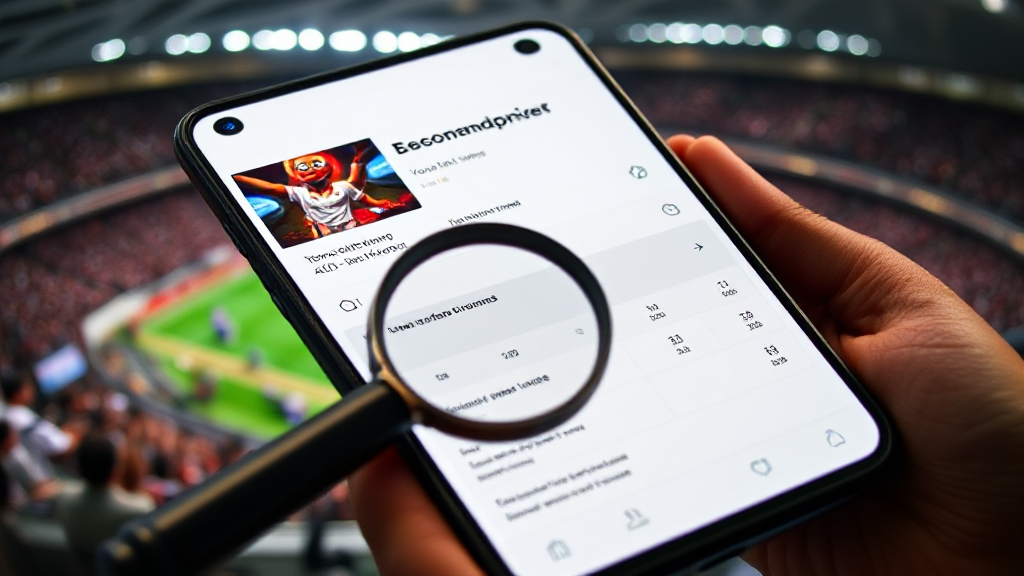
Headline Versus Detail: Reading a Yono New All Game Listing Honestly
Open any app store listing for a title that calls itself a Yono New All Game and you will meet two documents in one. The headline is loud, generous, and eager to please. The detail section is quiet, thin, and strangely reluctant to confirm what the headline just promised. One of them is trying to sell you something. The other is trying not to be held to it. So which one should a reader trust? That is the question this piece sets out to answer, and the answer is less flattering than the banner image suggests.
If you have spent any time comparing card-game apps, you already know that the gap between the promise and the paperwork is where most disappointment lives. A serious player learns to read the second half of the page first. For a broader sense of how listings are assessed and compared, Rummy Master is a useful reference point, because a review that separates marketing language from verifiable detail is doing the reader a genuine service.
The Headline Is Written to Be Believed, Not Checked
Headlines on these listings are not written by people who expect you to read them twice. They are written to survive a two-second glance. Words like “new,” “all,” and “master” are doing heavy lifting, and each one is deliberately vague enough to mean almost anything. “New” can mean newly released, newly updated, or new to this particular storefront. “All” suggests a complete collection, yet it never specifies what the collection contains. “Master” implies authority and completeness without committing to a single feature.
This is not unique to one app. It is the standard grammar of app-store copy, and it works because readers fill in the blanks themselves. When a headline says a listing is a Yono New All Game, the reader supplies the fantasy: every game, every mode, every variant, all in one place. The headline never actually says that. It only creates the conditions in which you say it to yourself.
A skeptical copy editor learns to underline the adjectives and circle the nouns. The adjectives are doing the persuading. The nouns are doing the promising. When the nouns are as broad as “game” and the adjectives as elastic as “all,” there is very little left to hold anyone accountable for. The headline is not a claim. It is a mood.
What the Detail Fields Actually Confirm
Scroll past the banner and the truth gets quieter. The detail fields on a typical listing of this kind tend to confirm only the basics: an app name, a category, a version number, a size in megabytes, a developer name that may or may not resolve to a real studio, and a privacy policy link that sometimes leads nowhere useful. These are the fields a platform requires. They are not the fields a player needs.
What is usually missing is more instructive than what is present. You will often find no clear statement of which specific games are included, no explanation of how the “all” in the title is bounded, no indication of whether the app requires an account, no transparent note on in-app purchases, and no plain-language summary of age eligibility. The detail section is technically compliant and practically silent. It tells you the app exists. It does not tell you what the app does.
This is where careful readers start taking notes. A listing that cannot answer basic questions in its own detail fields is not hiding the answers out of carelessness. It is hiding them because the answers would shrink the headline. The moment a listing specifies its contents, it loses the ability to imply that its contents are unlimited. Vagueness is not an oversight. It is the product.
The Gap Between the Promise and the Paperwork
Put the two halves side by side and the gap becomes easy to measure. The headline promises a universe. The detail section confirms a category. The headline implies completeness. The detail section lists a version number. The headline says “all.” The detail section says “card.” That distance is not a mistake in the copy. It is the copy’s whole strategy.
For players in India who are comparing rummy and card-game apps, this gap matters more than any single feature. A listing that overpromises in its title and under-delivers in its fields is telling you something about how it will behave after installation. If the store page cannot be precise, the app is unlikely to become precise later. The detail fields are the closest thing to a contract you will get before downloading, and a contract written in fog is not a contract at all.
The practical response is not cynicism but method. Read the detail fields first. Ask what is explicitly stated, not what is implied. If the title says “all” and the fields say nothing, treat the “all” as advertising and the silence as the actual specification. Then decide whether the specification is enough for you. Often it will not be, and that is a useful conclusion reached before installation rather than after.
It also helps to remember that listings are not written for careful readers. They are written for the scroll. The headline is optimized for the thumb; the detail fields are optimized for the platform’s review checklist. Neither is optimized for you. The reader who slows down and reads both halves is doing work the listing was never designed to reward, and that work is exactly what protects them.
The Verdict a Copy Editor Would Give
Trust the detail fields. Not because they are generous, but because they are the only part of the listing that can be checked. The headline is a mood; the detail section is a record, however thin. When the two disagree, the record wins, and when the record is silent, the silence is the answer. A Yono New All Game listing that cannot specify its own contents has told you what it is: a promise with no paperwork behind it.
None of this means every such listing is dishonest. It means every such listing should be read in the order a skeptical editor reads it: headline first to see what is being sold, detail fields second to see what is actually being offered, and the gap between them third to see what the seller hopes you will not notice. That gap is the most honest part of the page. It is the only part that has not been written to flatter you.